
René Bouché
Portrait of a Master

No other artist – with the exception of Warhol – so successfully blurred the line between fashion, art, celebrity and portraiture. René Bouché’s list of subjects reads like a who’s who of bold face, mid–century names. Time magazine, reviewing an exhibition in 1959, noted that, ‘He was not one to portray the bellhop or the country maid,’ and ranked him alongside Boldini and Sargent. Bouché no doubt would have appreciated the comparison; “I consider myself the avant-garde,” he said, “because nobody sings the song of the upper level of society. Nobody speaks of the exceptional human being”
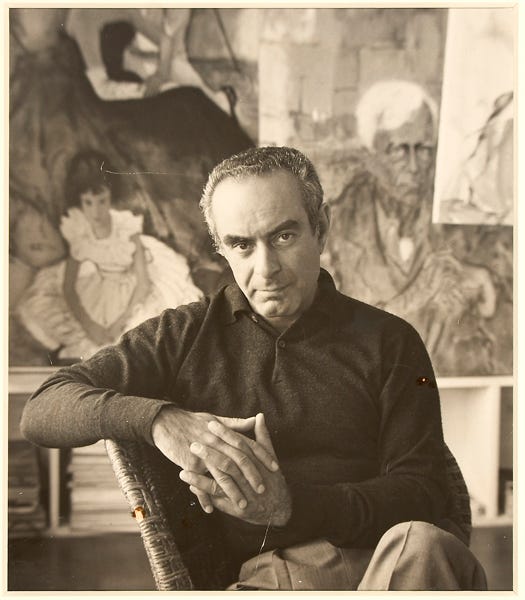
He was born René August Buchstein, to wealthy Jewish parents in Prague, in 1905. His mother died when he was nine and by the time he was in his mid-teens he had moved to Munich, where he studied Art History, supporting himself by illustrating children’s books. After a period in Berlin, during which he married the German artist Margo ‘Pony’ Schoenlank, he moved with his wife to Paris in 1934, where their son, Michel, was born.

In Paris, Bouché (he had adopted the surname while in Germany) studied at the Academie Ozenfant and worked for commercial clients including Nestlé, Ascott Shoes and Peugeot. His drawings began to appear regularly in the lifestyle magazine Plaisirs de France and, from 1938, in Vogue. His early work for the magazine had an easy, throw away assurance and was undoubtedly influenced by Eric and other illustrators of the top rank like Morgue and Pagés.
The war separated Bouché from his family. He joined the army, was captured and spent a period in a detention camp, from which he escaped and made his way via Lisbon to the United States. In America he joined up once more, but was given an honourable discharge a short time later, after sustaining serious injuries.
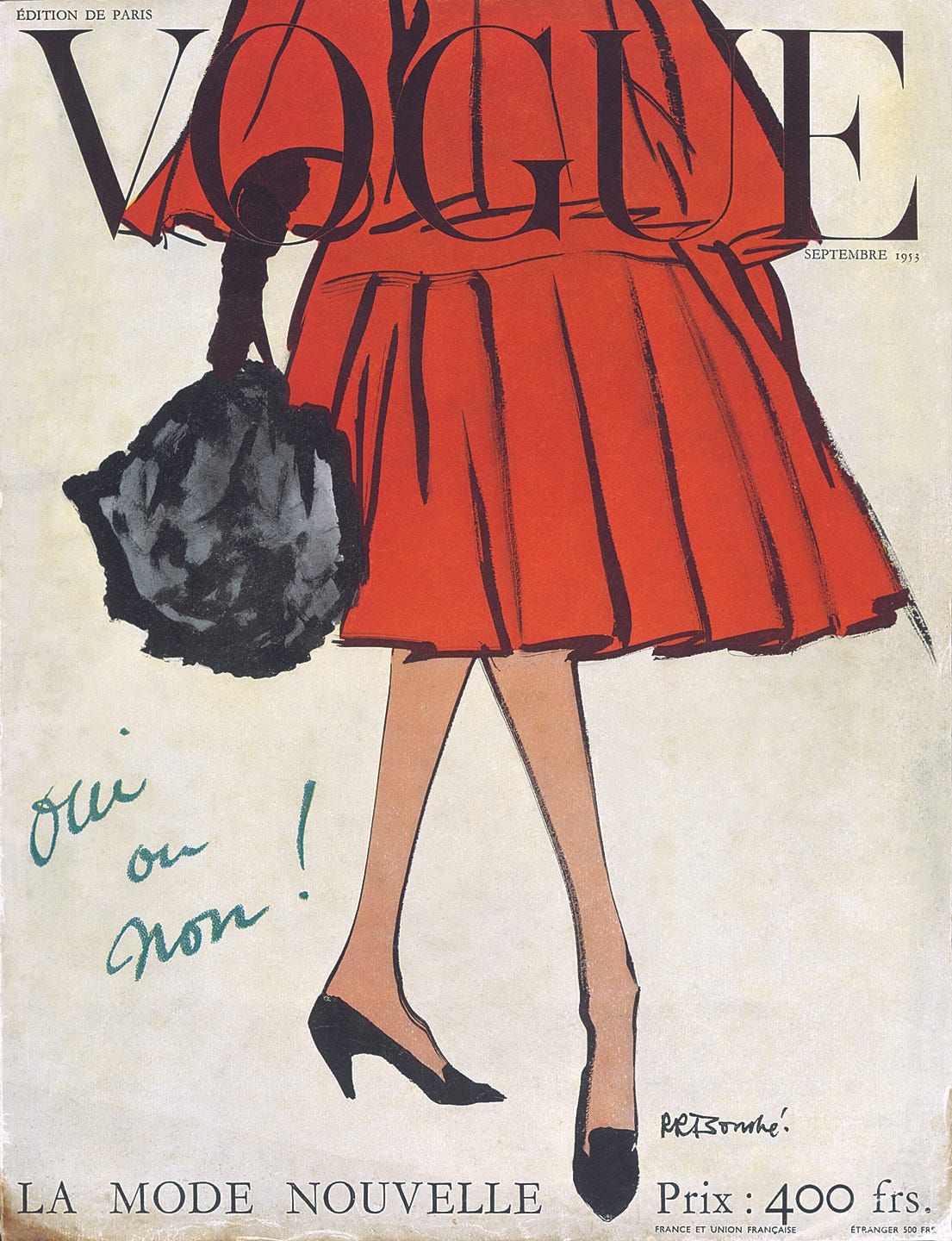
In 1941 he presented himself at the Vogue offices in New York to an underwhelming response. He was given six weeks to come up to scratch, which he did by shutting himself in his studio with a model. When he presented a new portfolio he was hired and although he was never officially under contract, he remained at Vogue until his death in 1963. Bouché now began to evolve his own style which was more flamboyant than Eric’s, his line more unpredictable, his eye a little sharper.
Bouché was now working steadily for Vogue. When the Queen Elizabeth was re-launched in 1946, he was on board as the magazine’s eyes and ears.He also sent back drawings from post war Madrid, Lisbon, Frankfurt and Paris. In the late 1940s he briefly became involved with the Abstract Expressionist Movement in New York, although he maintained his commercial clients including Elizabeth Arden, Charles of the Ritz and Saks Fifth Avenue
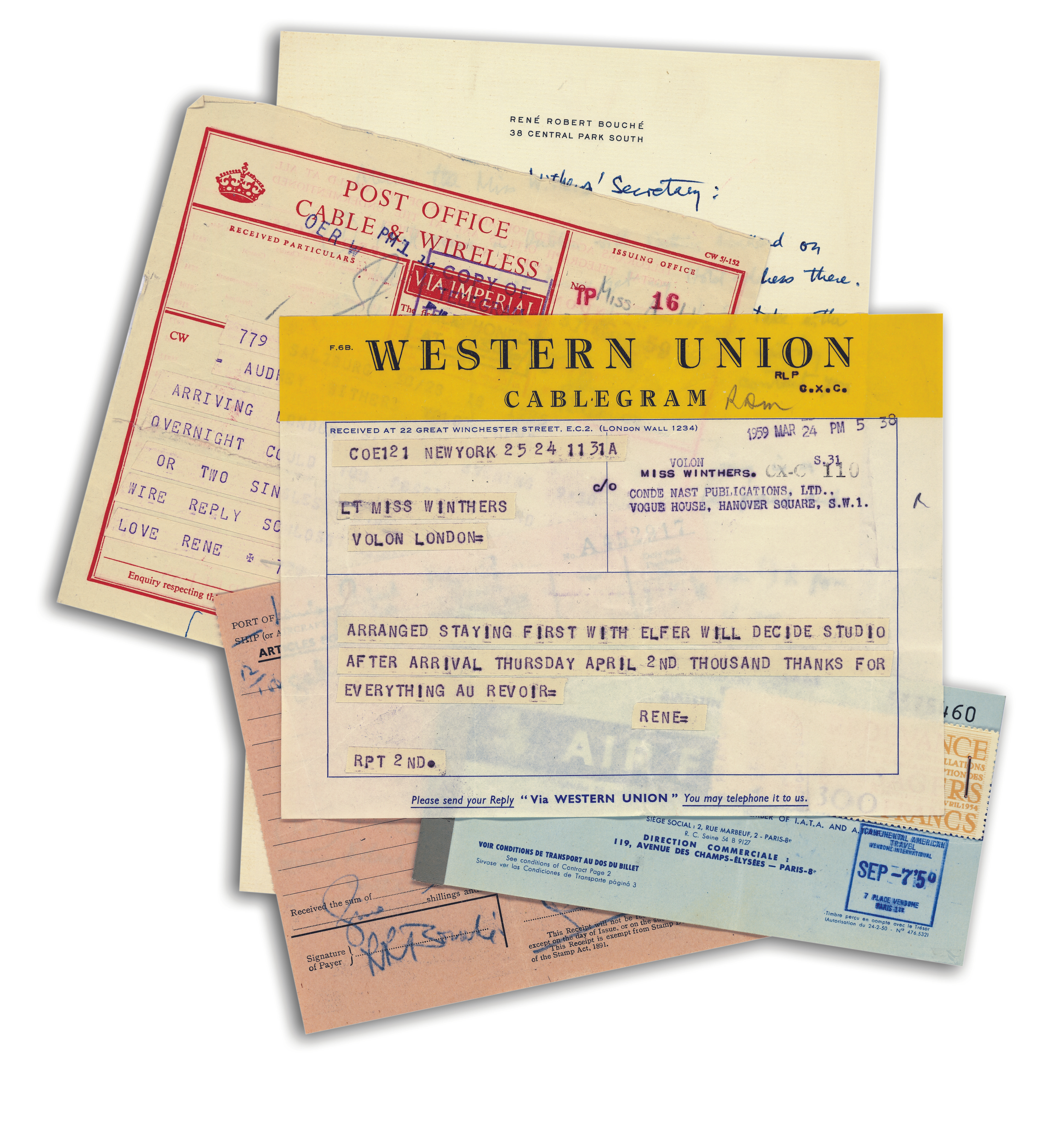
During the 1950s Bouché continued to produce travel pieces for Vogue, which showed how brilliant he could be when engaged, he went to Japan to study the rituals of Geishas, to Dublin for the horse races and to the French Riviera, where a lyrical set of drawings caught European aristocracy at play. And there was always the Paris couture; although Bouché sometimes seemed bored by American fashion, Dior, Givenchy and Balenciaga inspired him to some of his most memorable images. And, as a highly valued contributor at Vogue, he was certainly accorded star treatment; after the show, the chosen clothes (and the chosen model) would be rushed over to his penthouse suite at the Crillon – Garbo was a frequent next door neighbour – and work, however pressing, could always be halted for a civilised lunch on the terrace, with its views of the Place de la Concorde.
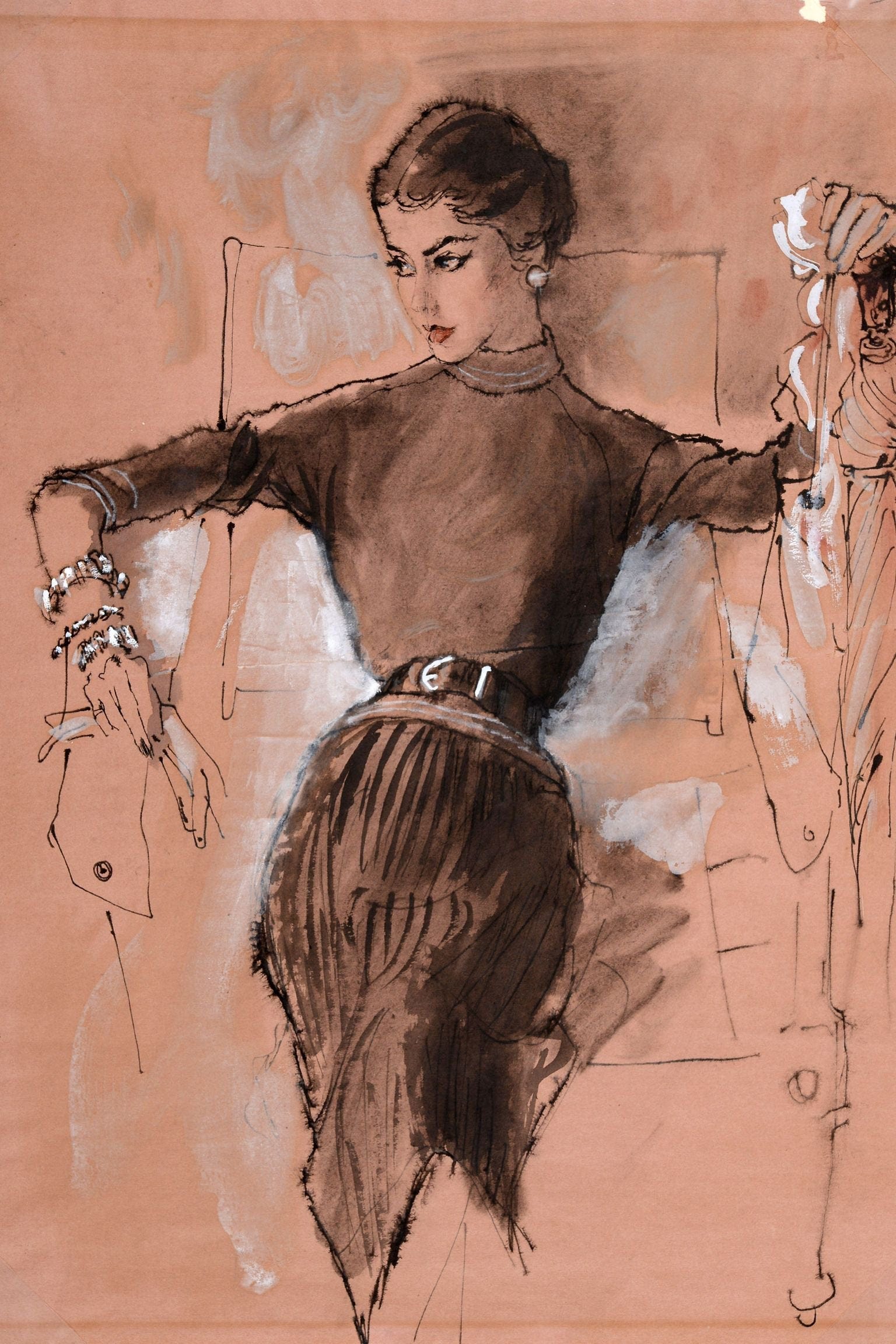
Bouché had great intensity and charm. “He got on with everybody…. except Cecil Beaton” according to his widow, Denise Bouche Fitch, whom he met as a junior editor at Vogue in 1956, and married in 1962 (although he reunited with Margo after the war, they divorced in 1954). The 1950s also saw Bouche’s emergence as a portraitist. Sitters, ‘significant contemporaries’, as Life magazine dubbed them, were invited to his studio at Central Park South where he worked to a soundtrack of loud Russian violins.
His charcoal sketches, many commissioned by Vogue, were linear, perceptive and had a lightening veracity. They could flatter, or not. Bouche described his work as a kind of ‘loving criticism’. He also produced a series of large scale oils of notable figures for the cover of Time magazine and undertook several private commissions a year (for fees of up to $10,000). Among the artists who sat for him were Braque, Da Cooning, Calder and Motherwell; writers included Capote, Auden, Huxley and Isaac Dinesen; entertainers Sinatra, Dietrich, Garland; Society swans Babe Payley, CZ Guest, Marella Agnelli ; musicians Stravinsky, Bernstein and Lenny Goodman and, perhaps most notably, President and Mrs Kennedy.
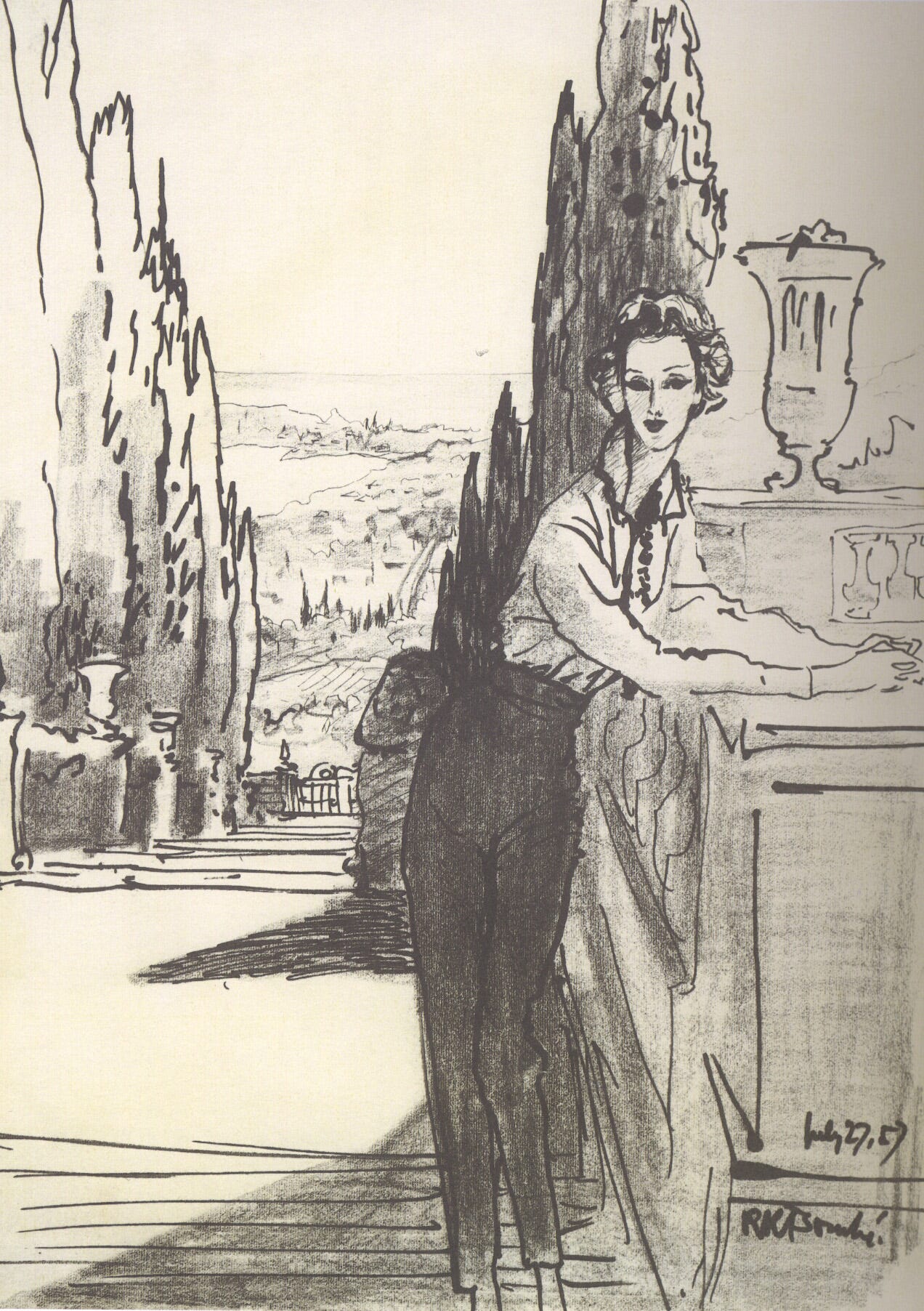
Bouché, never gave up his commercial commissions. He designed costumes and sets for Offenbach in the Underworld for the American Ballet Theatre, murals for the New York Hilton and he continued working for Vogue. His last, unfulfilled, commission, which he received on the day of his death in England, was to paint the Archbishop of Canterbury. In Vogue’s September 1963 obituary, William S. Lieberman, Chairman of 20th Century Art at the Metropolitan Museum looked back; “One evening not so long ago René Bouché spoke to me about his work. He said that he believed that warmth, dignity, elegance, and sophistication, even charm, are positive values for the painter, not to be effaced but rather to be nourished and kept beautiful. Although he admired the vanguard of American artists, his personal friends, he decided not to keep in step with them. He made a decision and quite deliberately set out to make his work and life one.. He succeeded.”

"He made a decision and quite deliberately set out to make his work and life one." Here is The Artist in its most refined sense. A la Midas, everything they touch turns to aesthetic pleasure.
A very interesting quote — “I consider myself the avant-garde,” he said, “because nobody sings the song of the upper level of society. Nobody speaks of the exceptional human being”
And I love the honesty when he described his work as a kind of ‘loving criticism’. Thanks David for enlightening us. 💘